
This isn’t a Mother’s Day thing. This is a mother’s everyday thing.
State of Motherhood 2026
How American Moms Are Really Doing
A national report on visible work, invisible coordination, and the mental load of running a home
Presented by: It’s a Family Thing!
Research conducted by: Talker Research for parenting app It’s a Family Thing!
Survey sample: 2,000 American mothers
Fielded: April 6 to April 10, 2026

Executive Summary
The Real Story
American mothers have more tools available to them than ever before. Families use shared calendars, reminder apps, smart devices, school portals, grocery apps, group texts, and digital schedules to coordinate daily life.
Yet the survey findings suggest that these tools have not eliminated one of the central pressures of modern motherhood: the responsibility for making sure family life keeps moving.
This report, based on a national survey of 2,000 American mothers conducted by Talker Research for the family app, It’s a Family Thing!, examines the visible and invisible work mothers carry at home. The findings show that motherhood in 2026 is not only defined by the number of tasks moms do, but also by the coordination role many play: remembering, reminding, tracking, planning, following up, and noticing what still needs to happen.
A majority of mothers say their household would stop running smoothly within a day or less if they were absent. That finding points to a deeper issue than busyness. It suggests that in many homes, the operating system of family life still depends heavily on one person.
The report finds that moms carry substantial visible household work, spend a significant share of their week in survival mode, and often lose rest and recovery time. It also finds that many mothers are responsible for the less visible coordination work that keeps households functioning, including tracking schedules, reminding family members, and following up to ensure tasks are completed.
The data suggests that many moms are not simply asking for more appreciation. They are asking for more shared responsibility, more rest, fewer reminders, better communication, and better follow-through.
The central finding is clear: the challenge facing many families is not only the amount of work involved in running a home. It is how unevenly that work, and especially the mental coordination behind it, is distributed.
Key Findings
#1 The household depends on mom
A majority of moms, 59%, say their household would stop running smoothly within a day or less if they were absent. The average reported breakdown point is 2.1 days.
#2 The visible work adds up
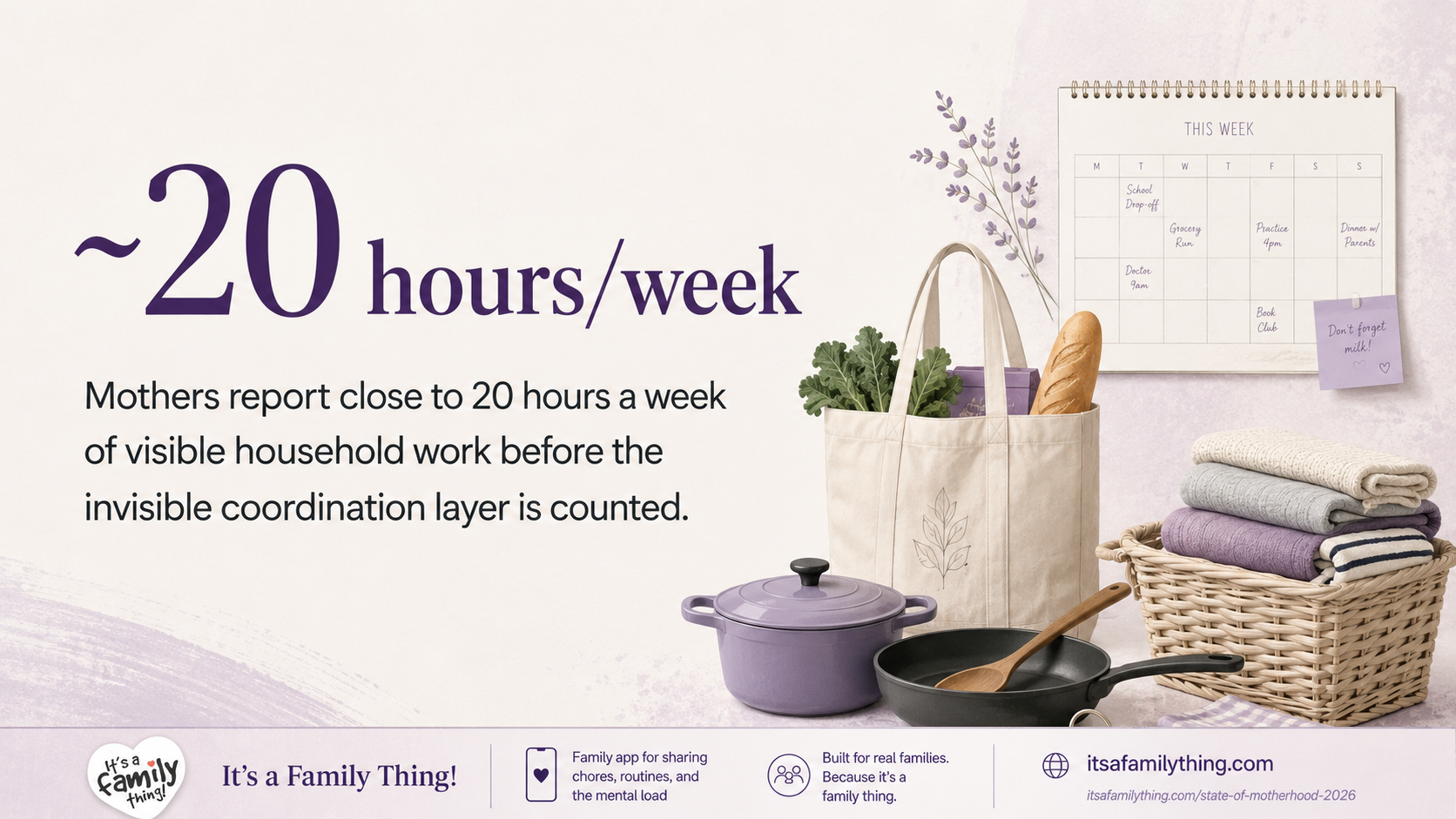
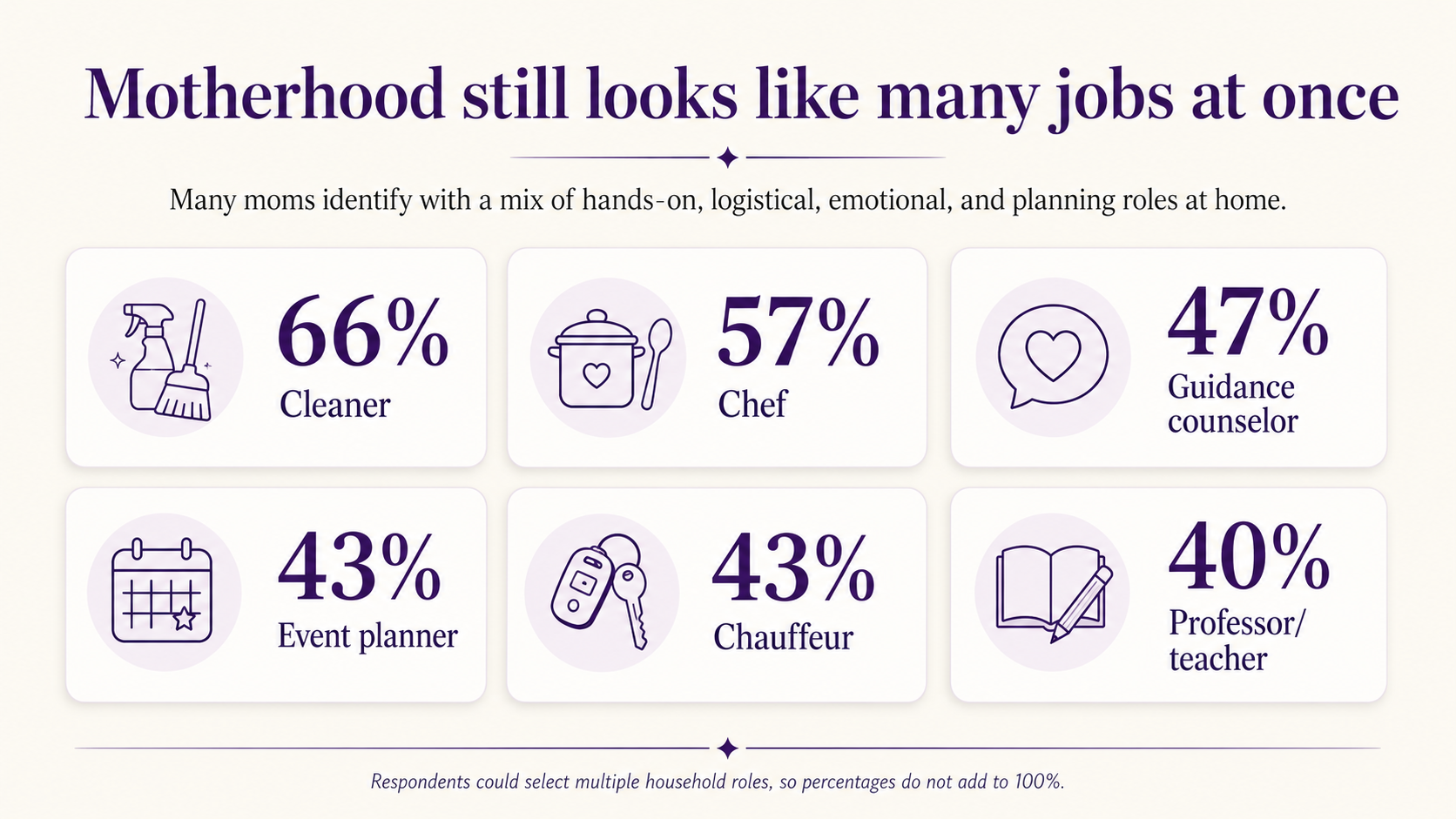
Mothers report close to 20 hours a week of visible household work. Large shares identify with household roles such as cleaner, chef, guidance counselor, event planner, and chauffeur.

#3 Survival mode is common
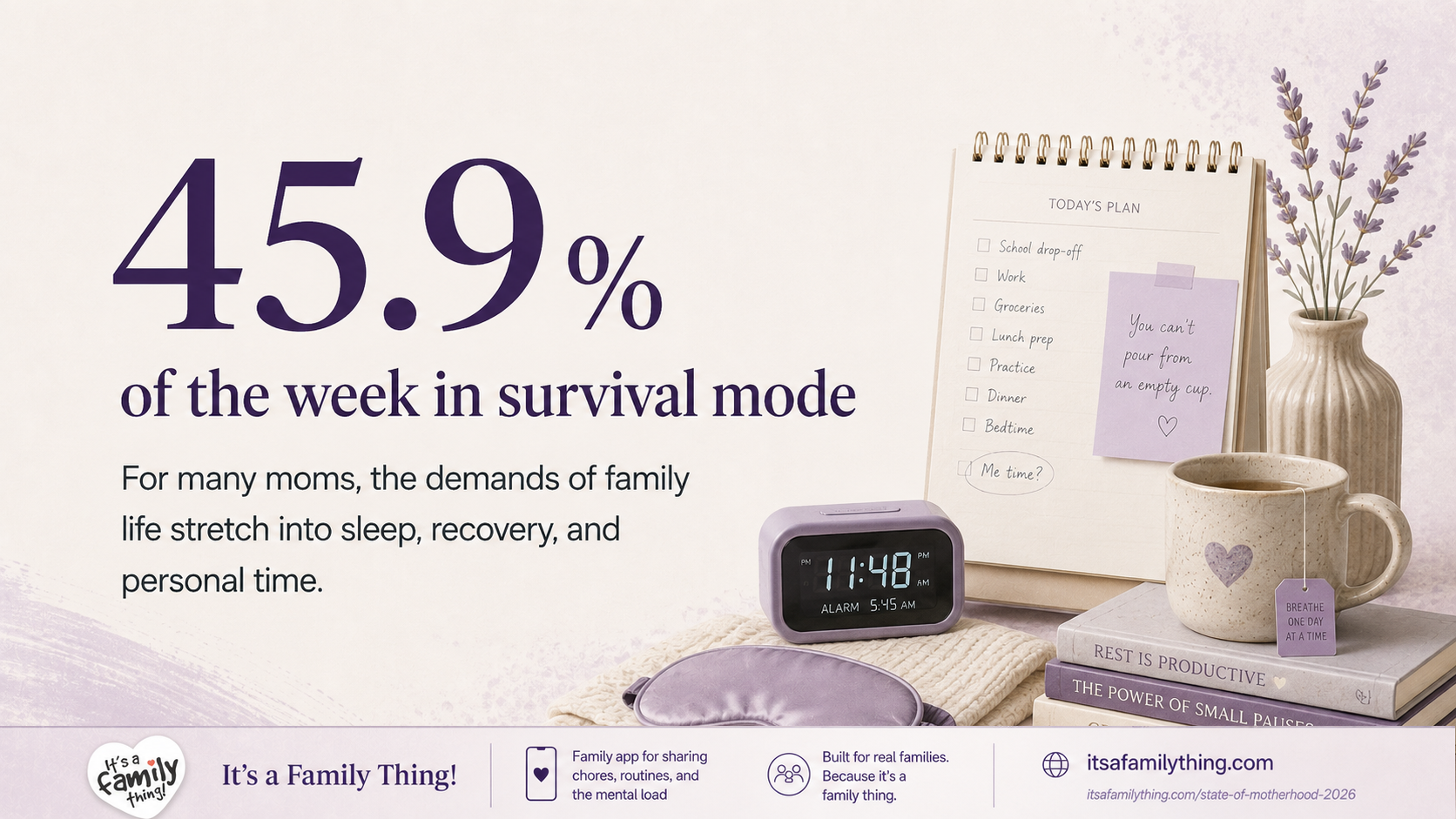
Moms report spending an average of 45.9% of the week in “survival mode.” Nearly two-thirds, 64%, get six hours of sleep or less per night. Nearly half, 47%, get one hour or less of pure relaxation per day.
#4 Coordination is the hidden layer
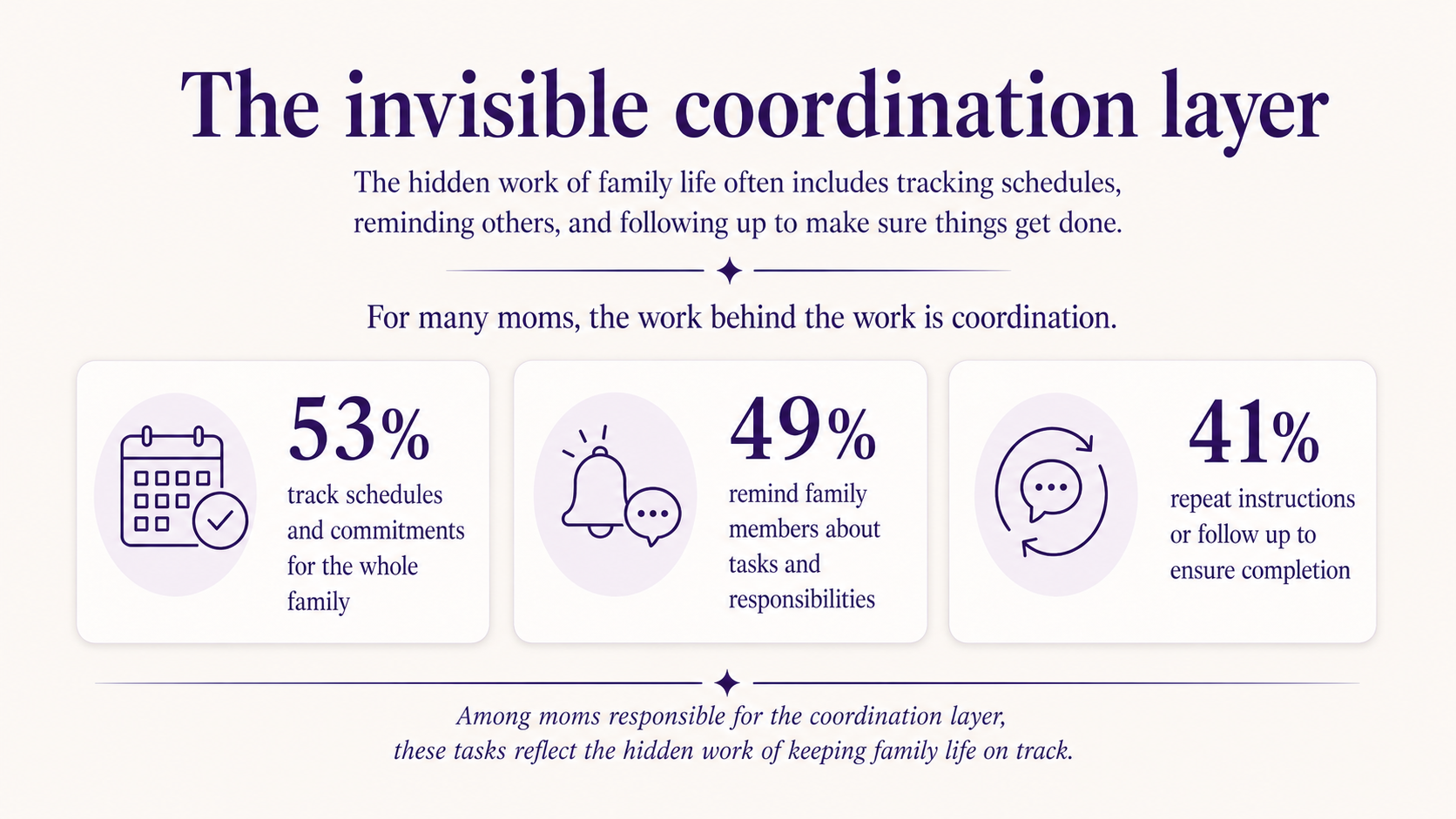
More than half of moms, 53%, say they track schedules and commitments for the whole family. Nearly half, 49%, remind family members about tasks and responsibilities. Four in ten, 41%, repeat instructions or follow up to make sure things get done.

#5 Follow-up has an emotional cost
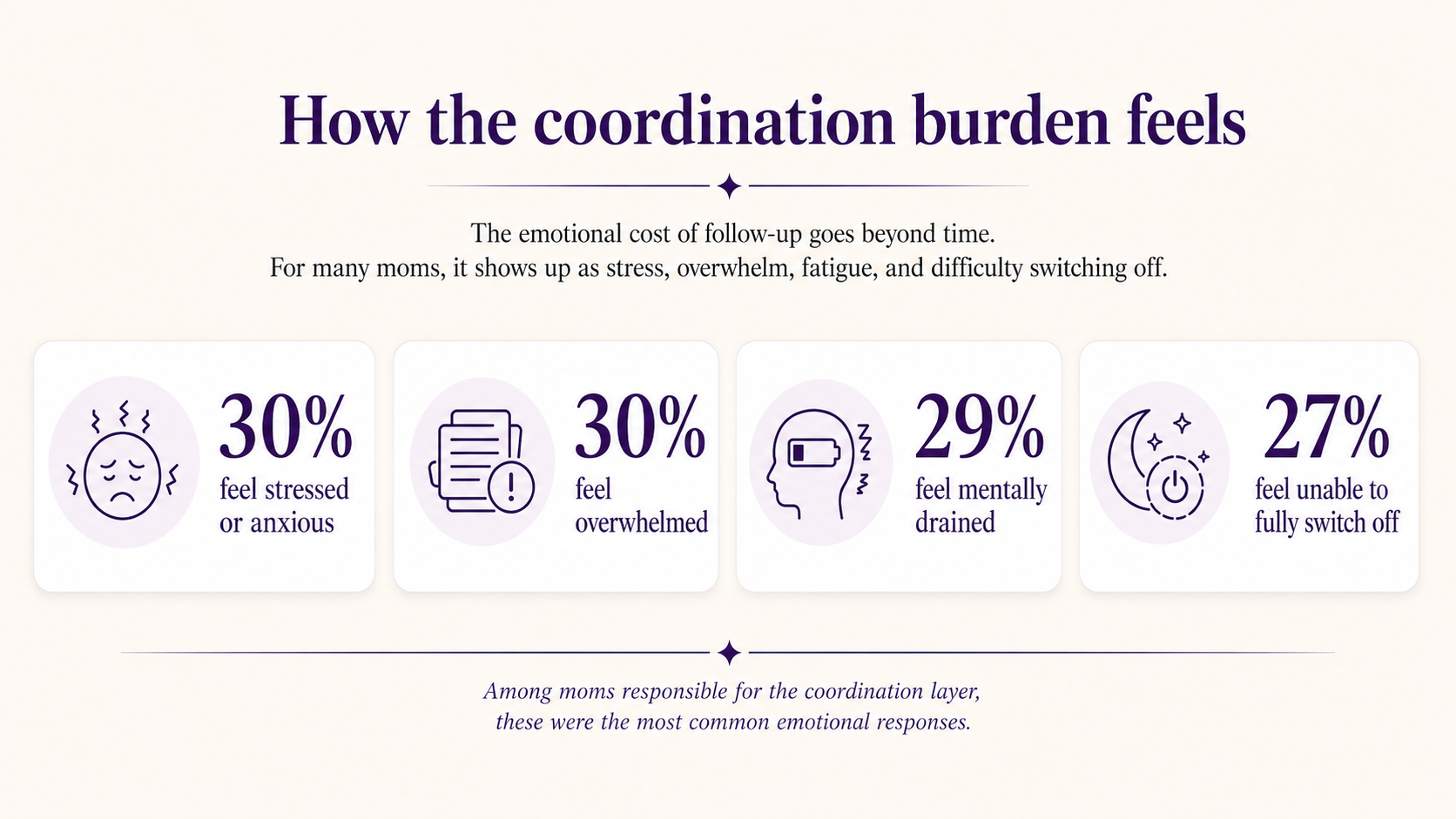
Among moms responsible for the coordination layer, 30% say it makes them feel stressed or anxious, 30% feel overwhelmed, 29% feel mentally drained, 29% feel like they are the only one keeping things running, and 27% feel unable to fully switch off.
#6 Relief means shared responsibility
When asked what would reduce their day-to-day mental load, moms most often point to more help from family members, 34%, more time to rest and recharge, 33%, not having to remind others, 29%, and better communication within the household, 26%.
#7 Work-life spillover is real
About the Survey
This report is based on a survey of 2,000 American mothers conducted online by Talker Research for the family app, It’s a Family Thing! between April 6 and April 10, 2026.
The survey explored how moms experience household responsibilities, visible work, invisible coordination, survival mode, sleep, relaxation, family dependence, and the kinds of support that would reduce their day-to-day mental load.
Throughout this report, the phrase “visible work” refers to household tasks that are easier to identify and measure, such as cleaning, cooking, driving, shopping, planning, and family logistics.
The phrase “invisible coordination” refers to the less visible work of keeping family life moving, such as remembering what needs to happen, tracking schedules, reminding family members, repeating instructions, following up, and noticing when responsibilities fall through the cracks.
1. The Visible Work of Motherhood
Moms report doing the equivalent of a part-time job at home
Before examining invisible coordination and mental load, it is important to understand the visible work many moms already carry.
Visible household work alone adds up quickly, spanning cooking, cleaning, driving, planning, shopping, and other routine responsibilities that keep family life moving.
When asked which job titles reflect how they contribute to their families, many mothers identify with roles that are practical, emotional, and logistical.
These findings show that mothers continue to play multiple roles inside family life. The roles are not limited to physical tasks. Many involve emotional support, planning, teaching, transportation, and household coordination.
At the same time, this is not a story about mothers who are failing to manage family life. Many moms describe themselves as capable, encouraging, patient, empathetic, and able to handle multiple responsibilities. The issue is not capability. The issue is capacity.
The visible work already adds up. The invisible work adds another layer.
2. Survival Mode and the Compression of Rest
The workload stretches into sleep, recovery, and personal time
The survey suggests that the demands of family life do not stay neatly contained within the day. They affect rest, sleep, recovery, and the amount of time mothers have for themselves.
Moms report spending an average of 45.9% of the week in “survival mode,” described as doing everything that needs to be done in the moment while feeling stressed, anxious, or barely getting by.
Sleep and relaxation are also limited for many mothers. Nearly two-thirds get six hours of sleep or less per night, and nearly half get one hour or less of pure relaxation per day.
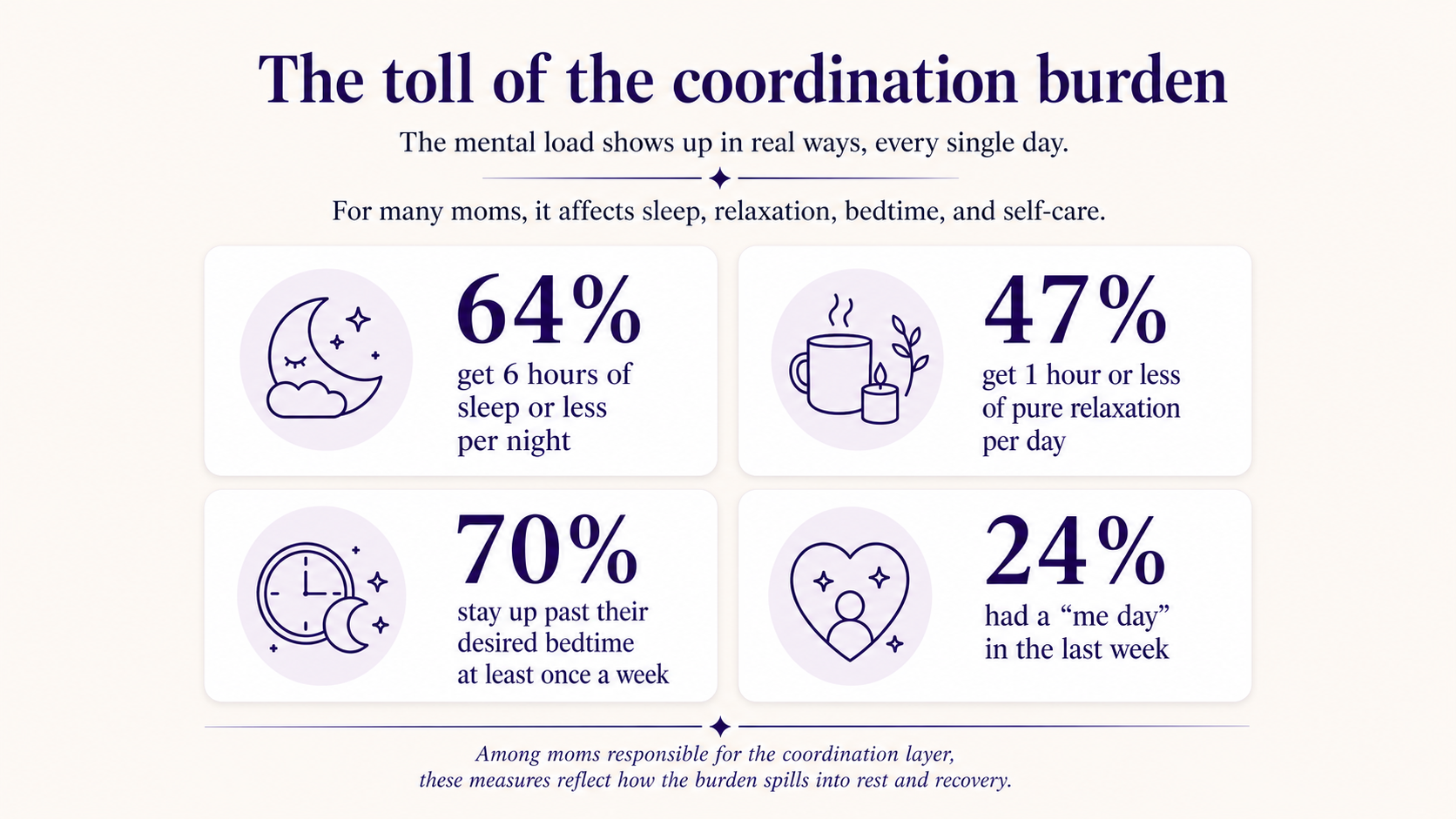
These figures point to a pattern of compression. The work of family life expands into the margins of the day, while recovery time narrows.
Nearly half of mothers report getting one hour or less of pure relaxation per day. That is not just a sign of occasional stress. It suggests that for many mothers, limited rest has become part of the routine.
3. The Invisible Coordination Layer
The problem is not only the work. It is the reminding and follow-up.
Much of family life depends on coordination. Schedules need to be tracked. Children need reminders. Tasks need follow-up. Someone has to notice what is missing, what is late, what has been forgotten, and what needs to happen next.
This work is often less visible than cooking dinner or driving to practice, but it is central to how households function.
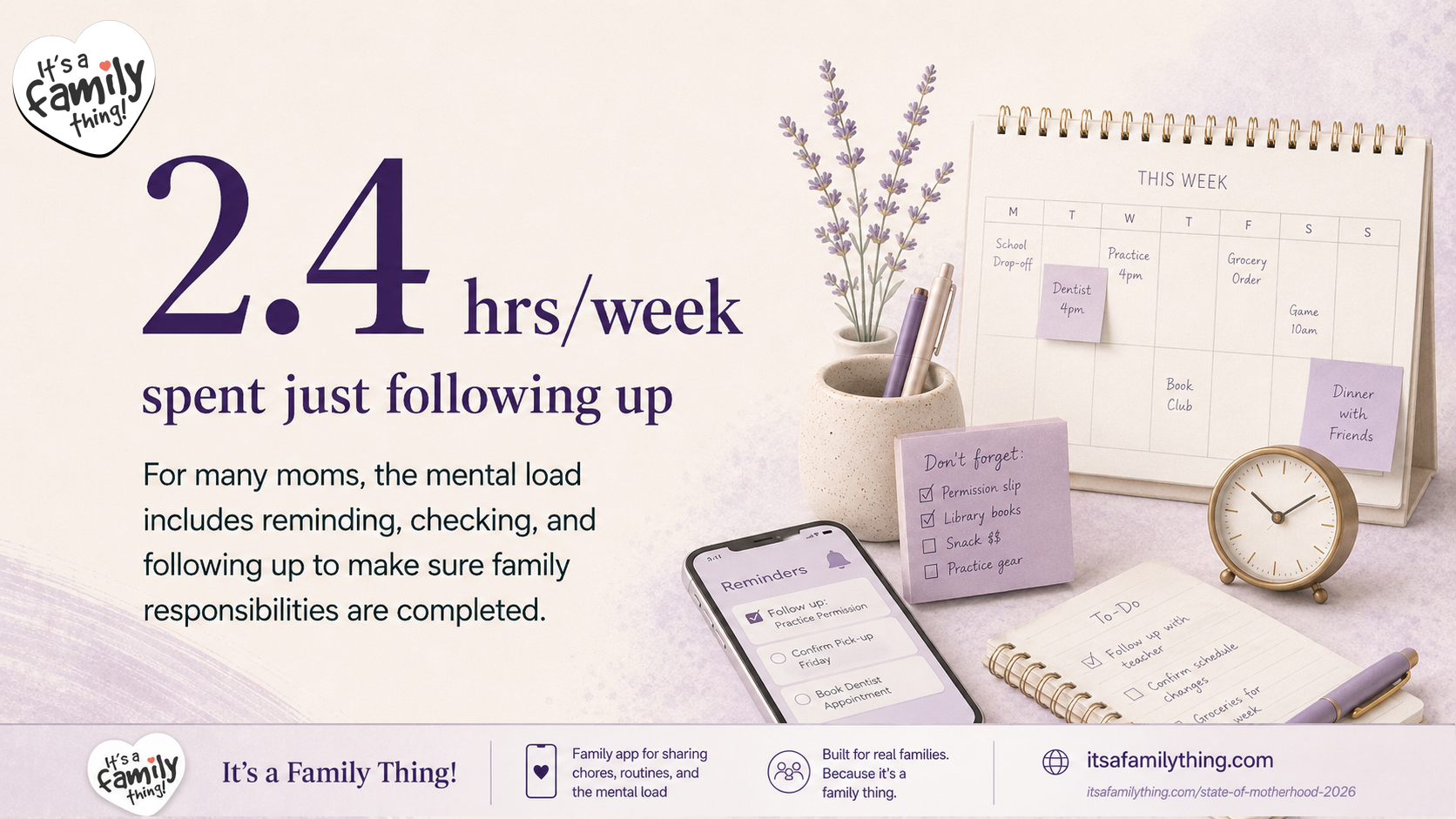
The survey finds that more than half of moms track schedules and commitments for the whole family. Nearly half remind family members about tasks and responsibilities. Four in ten repeat instructions or follow up to make sure things get done.
A family calendar can show what needs to happen, but it does not make the family act on it. A reminder can be sent, but someone still has to notice whether the task was completed. A chore chart can list responsibility, but someone often has to follow up when the responsibility is missed.
This is the work behind the work. It is fragmented, recurring, and easy to overlook. But when it is not done, the household feels it.
4. The Emotional Cost of Follow-Up
The mental load is not only measured in hours
The survey also asked mothers how the responsibility of reminding, organizing, and following up makes them feel.
Among moms responsible for this coordination layer, the most common responses point to stress, overwhelm, mental fatigue, and difficulty switching off.
These findings help explain why the mental load is different from a checklist of tasks.
A task can be completed. The responsibility for remembering, tracking, anticipating, and following up often continues. That responsibility can make it difficult for moms to fully rest, even when no visible task is happening in the moment.
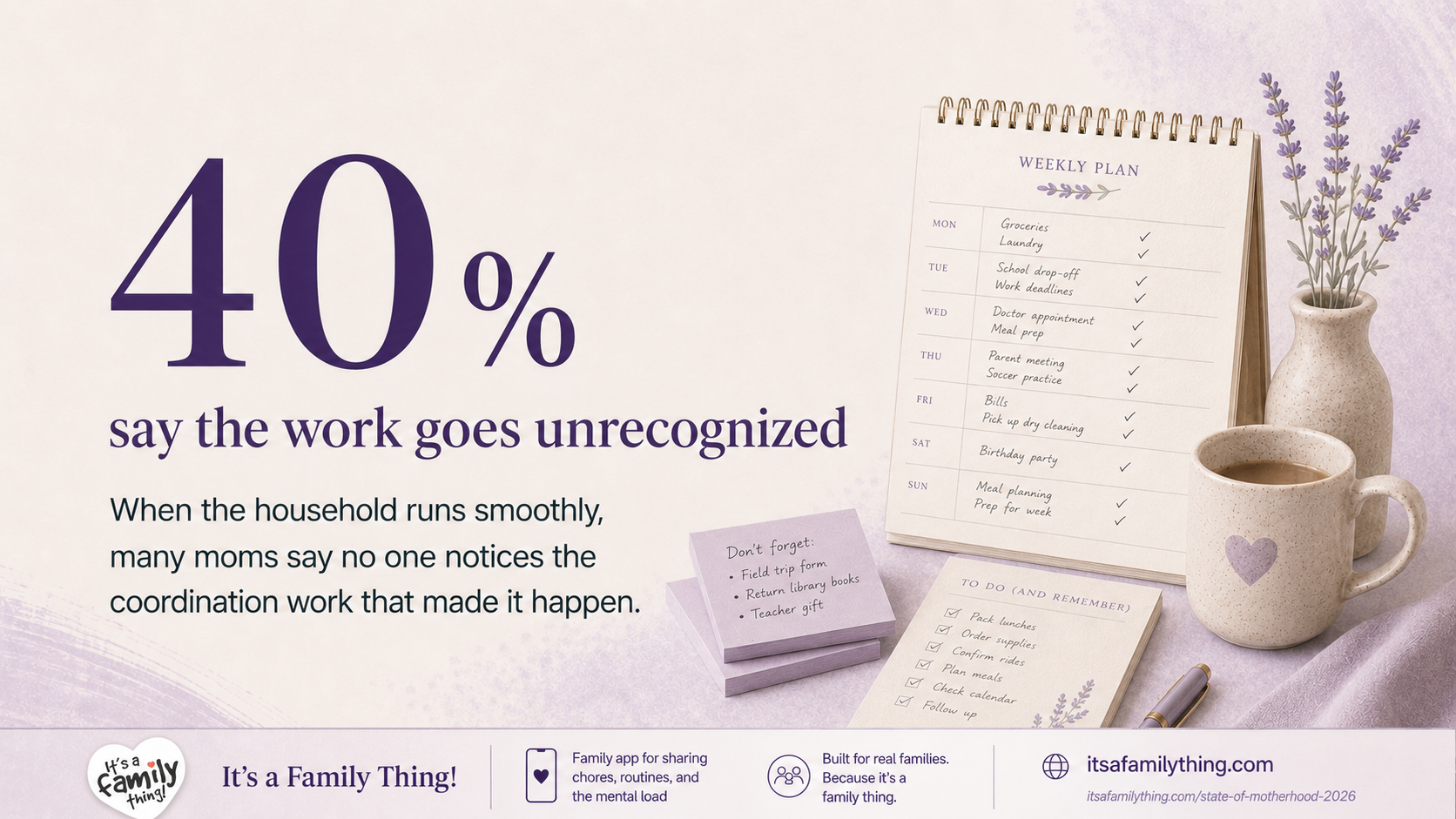
The data also points to an invisibility problem. When the household runs smoothly, 40% of moms say no one gets credit. Not even them.
This matters because invisible work is often noticed only when it fails. When schedules are managed, tasks are completed, and routines happen, the effort behind that coordination can disappear into the background.
5. Household Dependence on Mom
Many households feel the strain quickly when mom steps away
One of the clearest signs of unevenly distributed responsibility is how quickly a household is expected to stop running smoothly when one person is absent.
A majority of mothers, 59%, say their household would stop running smoothly within a day or less if they were absent. The average reported breakdown point is 2.1 days.
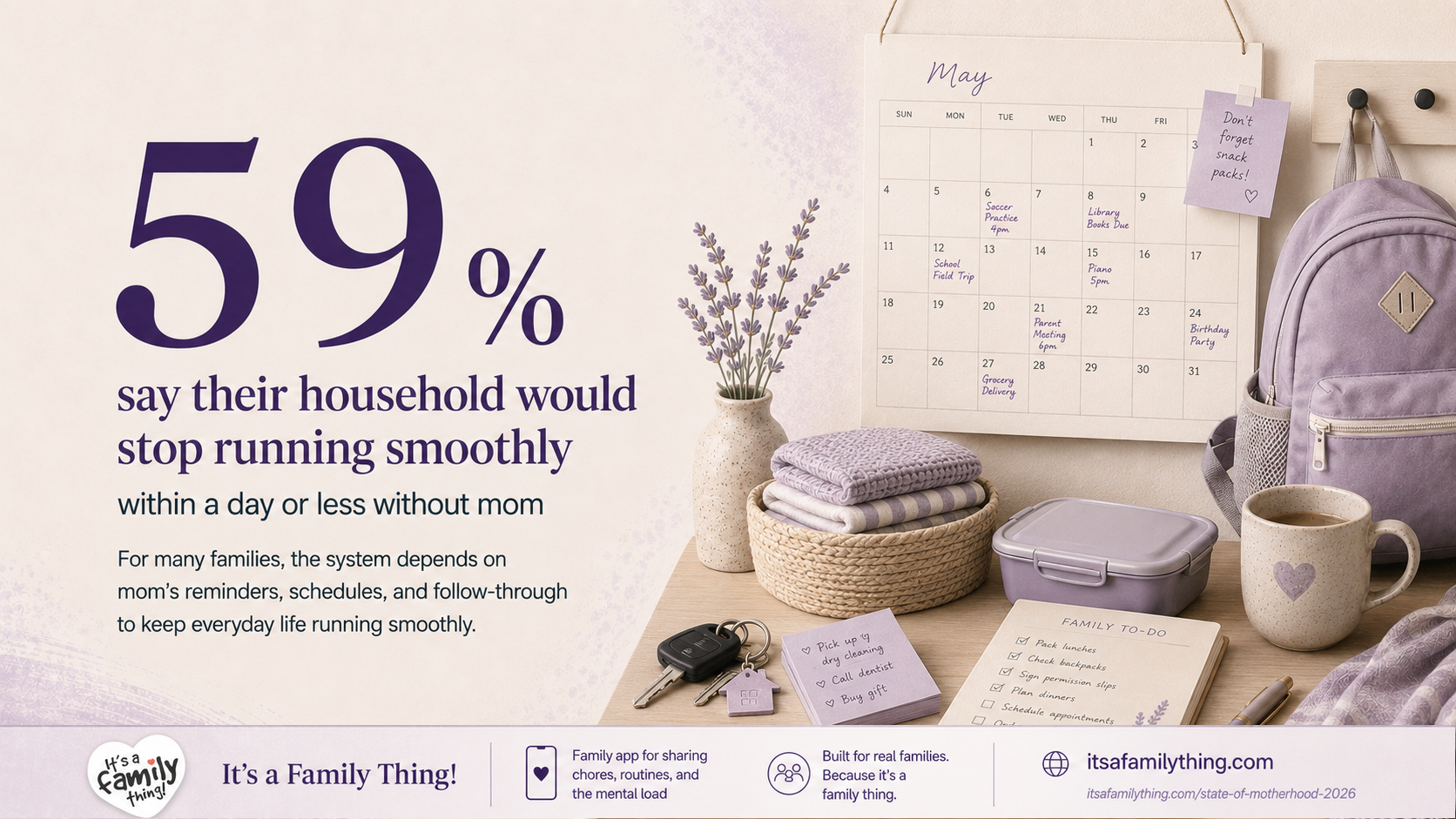
This does not mean households could not function without mothers. Rather, it suggests that much of the operating knowledge, anticipation, and follow-through may still be concentrated in one person.
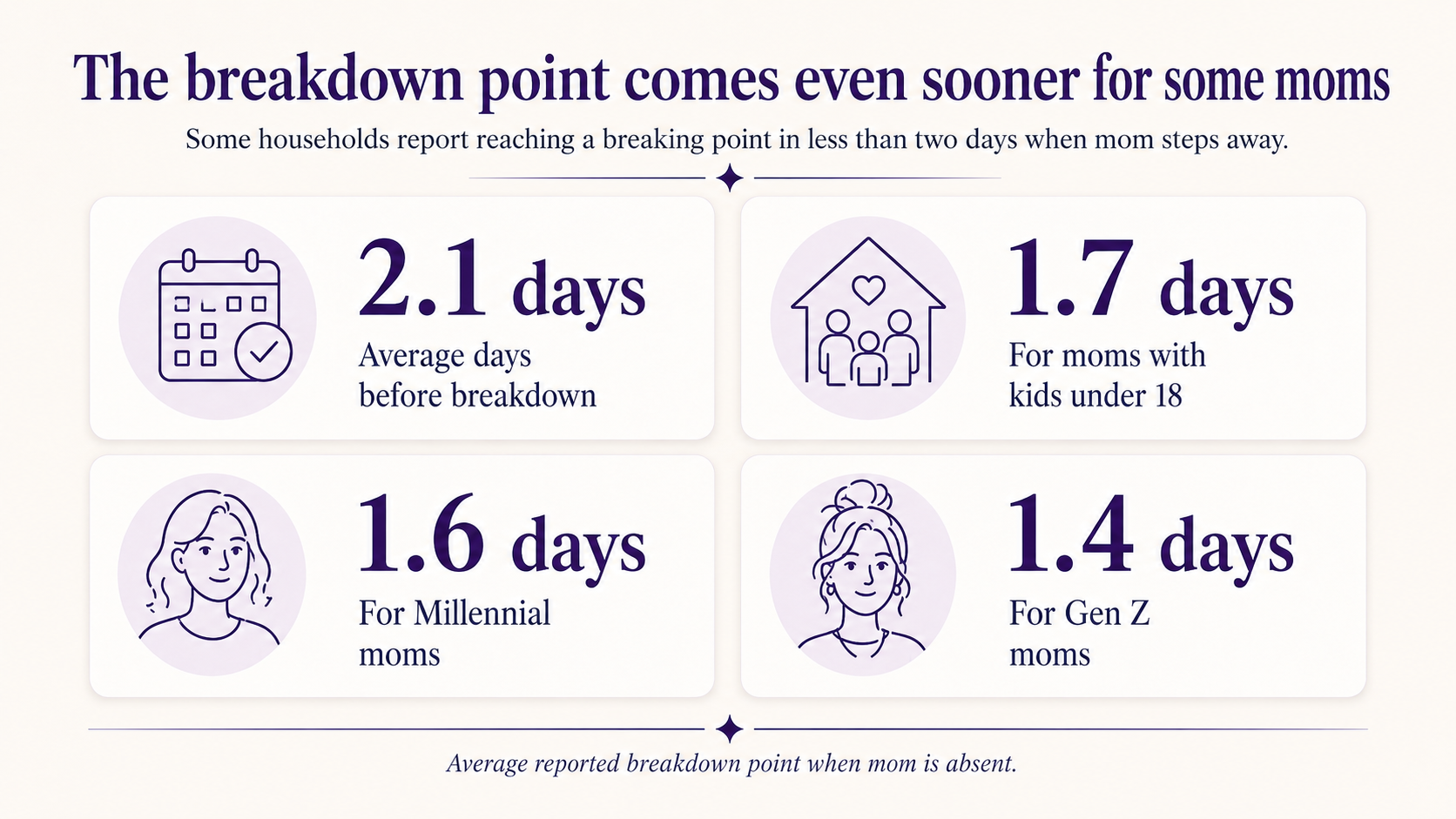
When one person carries the reminders, schedules, routines, and next steps, the household can function day to day. But it also becomes fragile. The system depends on one person’s attention.
In that sense, the 59% figure is not just a workload statistic. It is a dependence statistic.
6. Moms With Children at Home Face Higher Pressure
The active parenting years appear to be especially compressed
Mothers with children still at home report higher levels of pressure across several measures.
Among moms with kids under 18, the survey finds more time spent in survival mode, more nights staying up late, more hours spent on follow-up, and a shorter average household breakdown point.
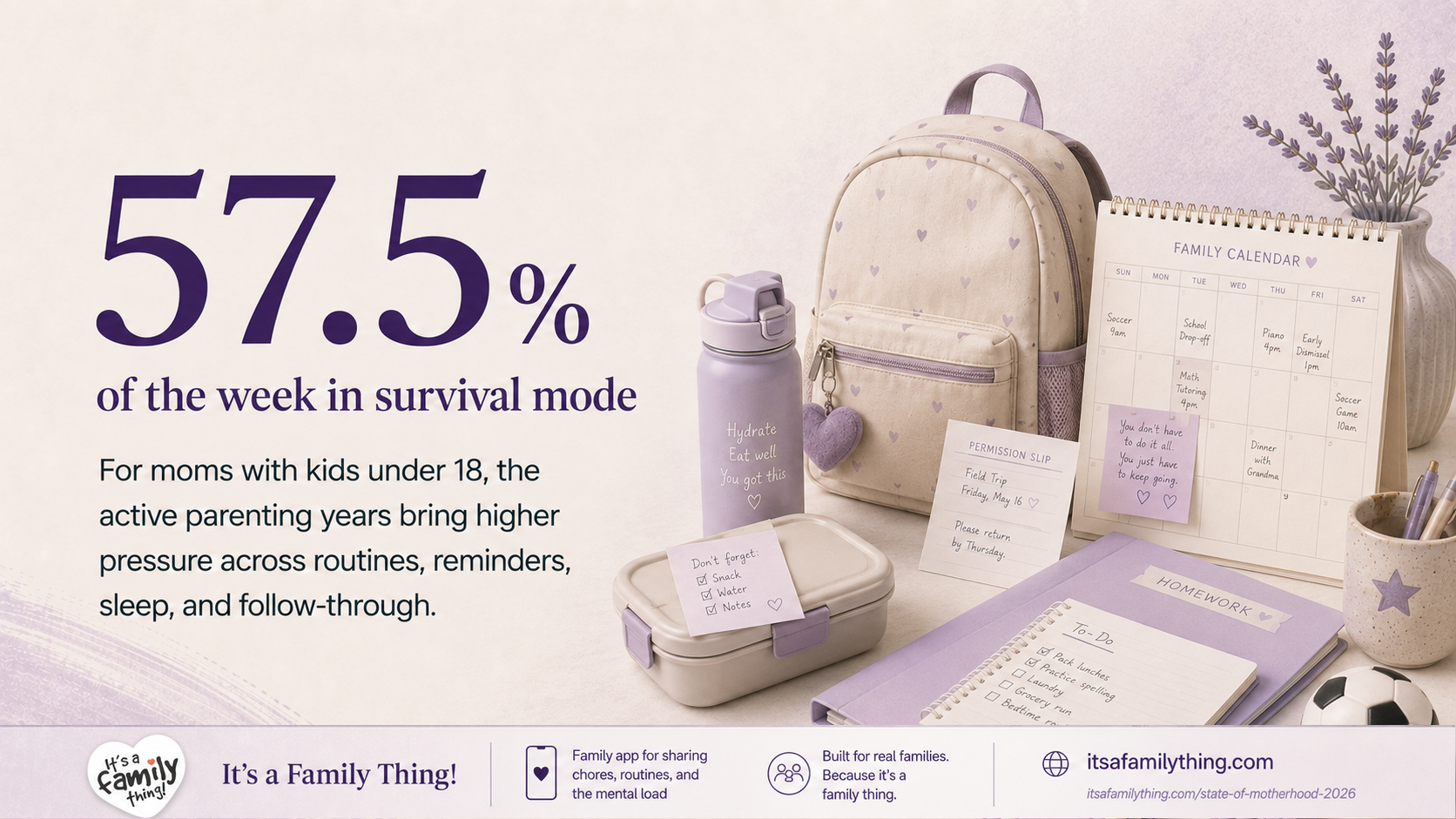
These years are often the period when routines, independence, school responsibilities, activities, and family logistics are most active. They are also the years when children are still learning how to follow through on responsibilities without constant prompting.

That makes this period especially important. The same years when children need structure and shared responsibility are also the years when mothers may be carrying the most operational pressure.
7. Millennial Moms Are Especially Stretched
More tools have not necessarily meant more relief
Millennial moms grew up with digital tools and entered parenthood during a period of rapid growth in apps, reminders, online school portals, smart devices, and shared calendars.
But the survey suggests that more tools have not necessarily translated into a lighter load.
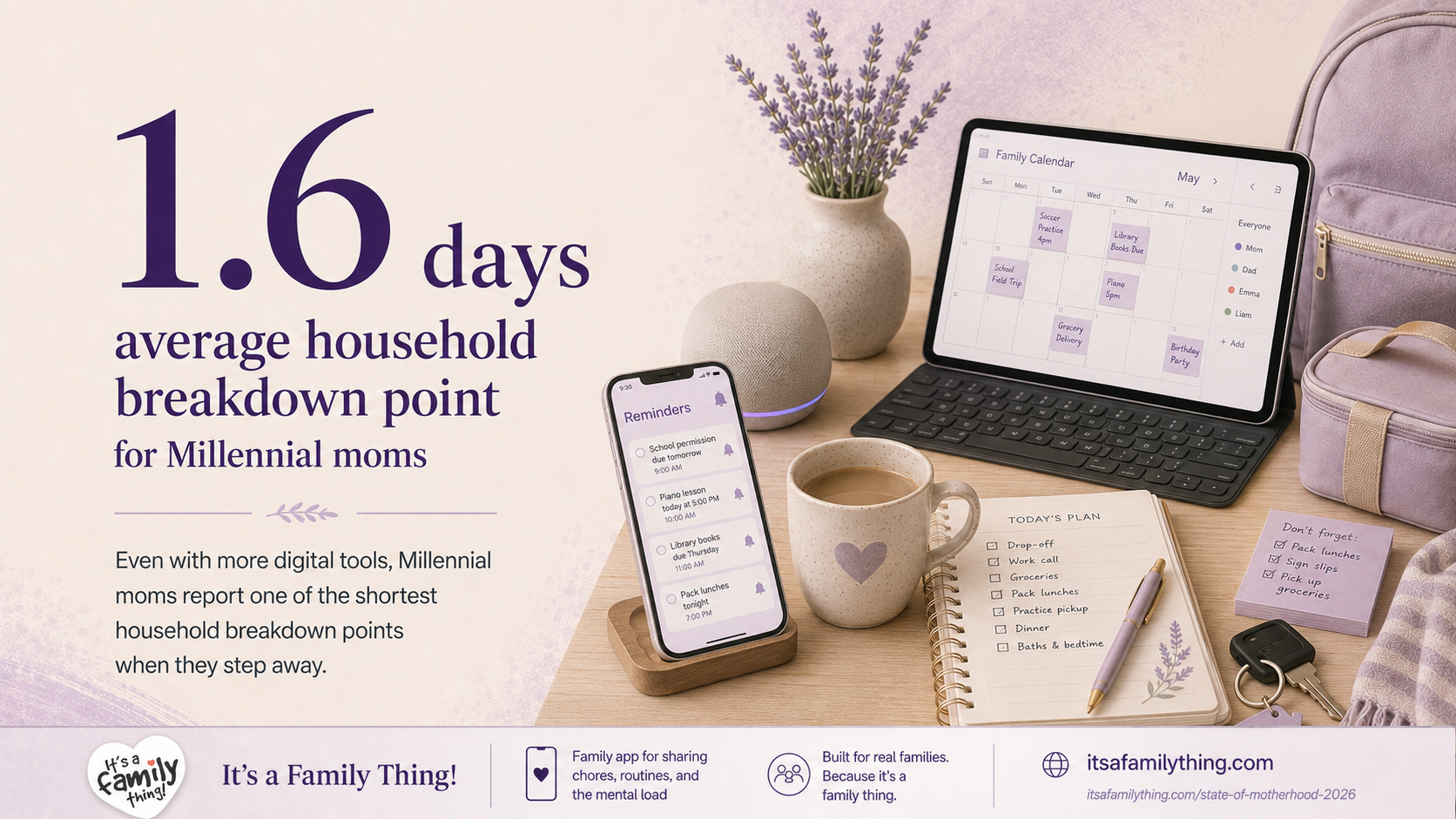
Millennial moms appear especially stretched across several measures, including survival mode, mental drain, sleep, and household dependence.
The pattern suggests that the availability of tools is not the same as the distribution of responsibility.
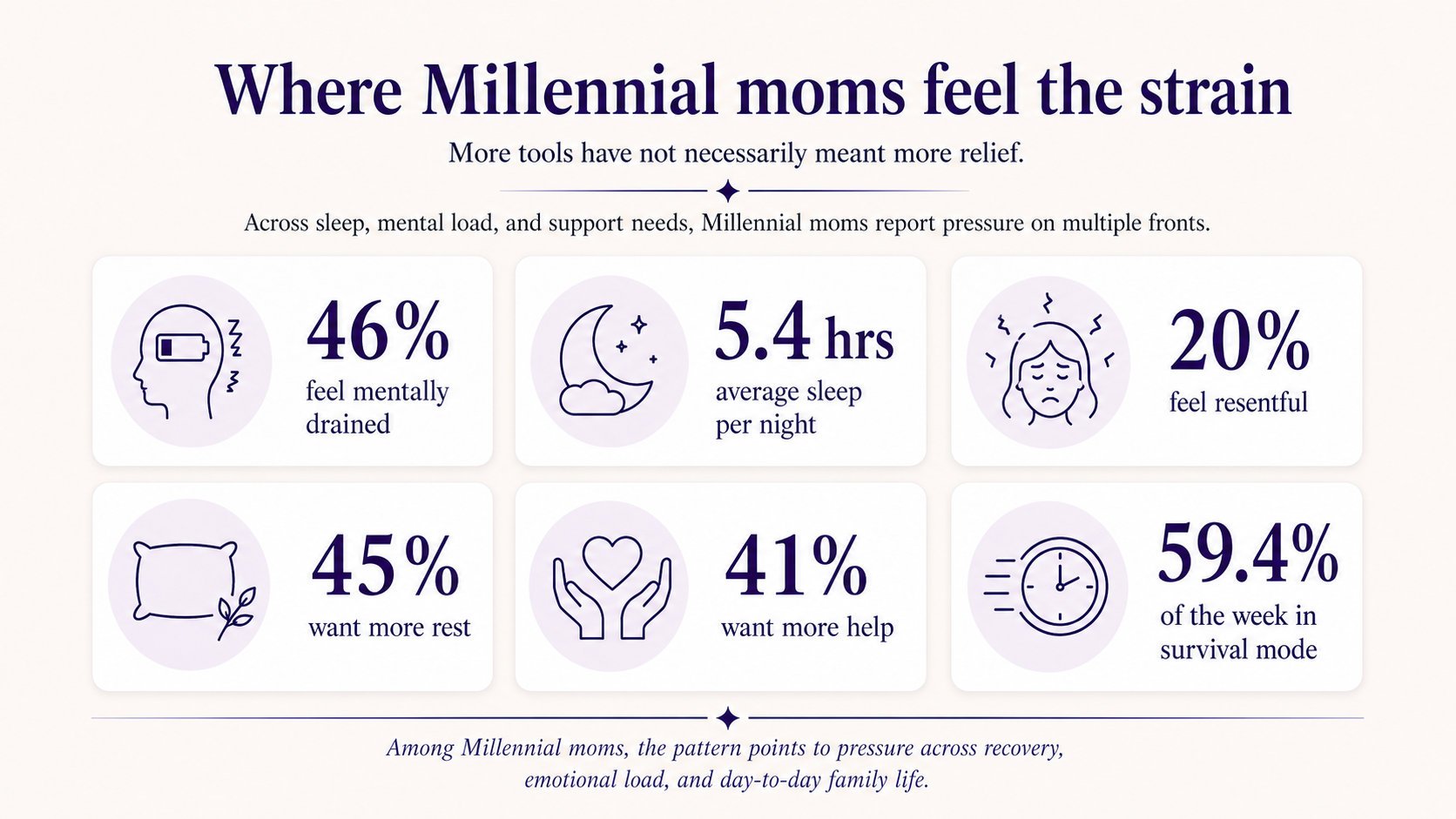
A shared calendar still requires someone to maintain it. A reminder still requires someone to set it, monitor it, and follow up. A school portal still requires someone to check it. A family app still requires the family to participate.
For Millennial moms, the issue may not be a lack of tools. It may be that the tools still route too much responsibility through one person.
8. Work and Family Pressure Move in Both Directions
For working moms, home affects work, and work affects home
Working motherhood is often discussed as a work-life balance issue. But the survey suggests that balance may not be the right word.
For many working moms, the pressure moves in both directions.
Burnout and fatigue from family life can affect work quality. Burnout and fatigue from work can affect family life and commitments. The result is not a clean separation between home and work. It is a spillover loop.
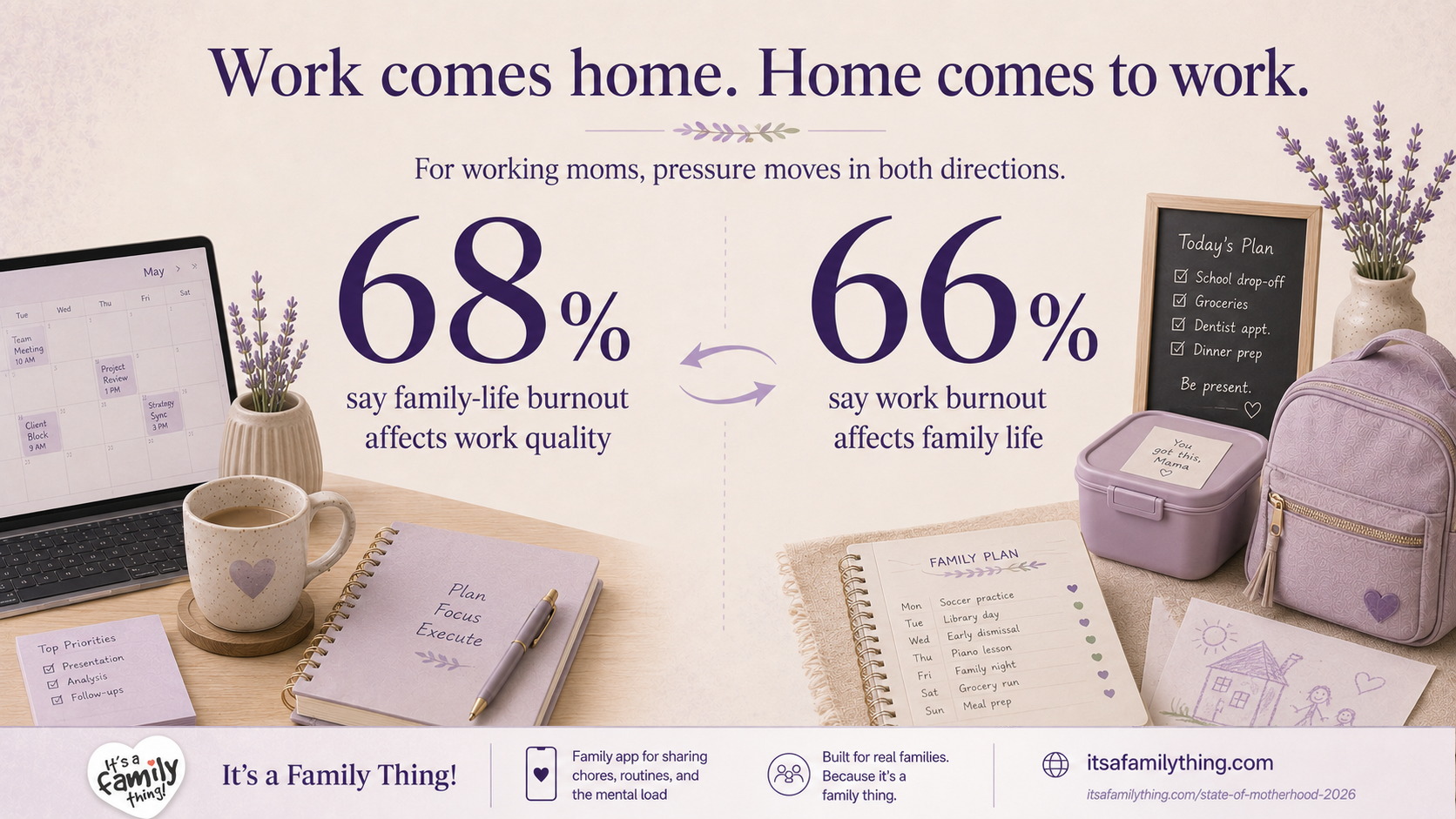
Among full-time working moms, 68% say burnout or fatigue from family life negatively impacts their work quality at least sometimes. At the same time, 66% say burnout or fatigue from work negatively impacts their family life or commitments at least sometimes.
That means the invisible work of family life does not stay outside office hours. It can show up as reduced focus, lower energy, emotional fatigue, and less recovery time.
For employers, this matters. Supporting working parents is not only about flexibility after someone is already stretched. It is also about understanding the family load that employees may be carrying before they even start the workday.
The data points to a simple workplace truth: supporting parents is not only about helping them manage work. It is also about recognizing the unpaid coordination work they carry at home.
When family life depends on one person remembering, reminding, planning, and following up, the impact can follow that person into the workday.
9. What Moms Say Would Reduce Their Mental Load
Moms are asking for shared responsibility, rest, and fewer reminders
When asked what would reduce their day-to-day mental load, mothers point to practical forms of relief.
The top responses are more help from family members, more personal time to rest and recharge, not having to remind others, and better communication within the household.
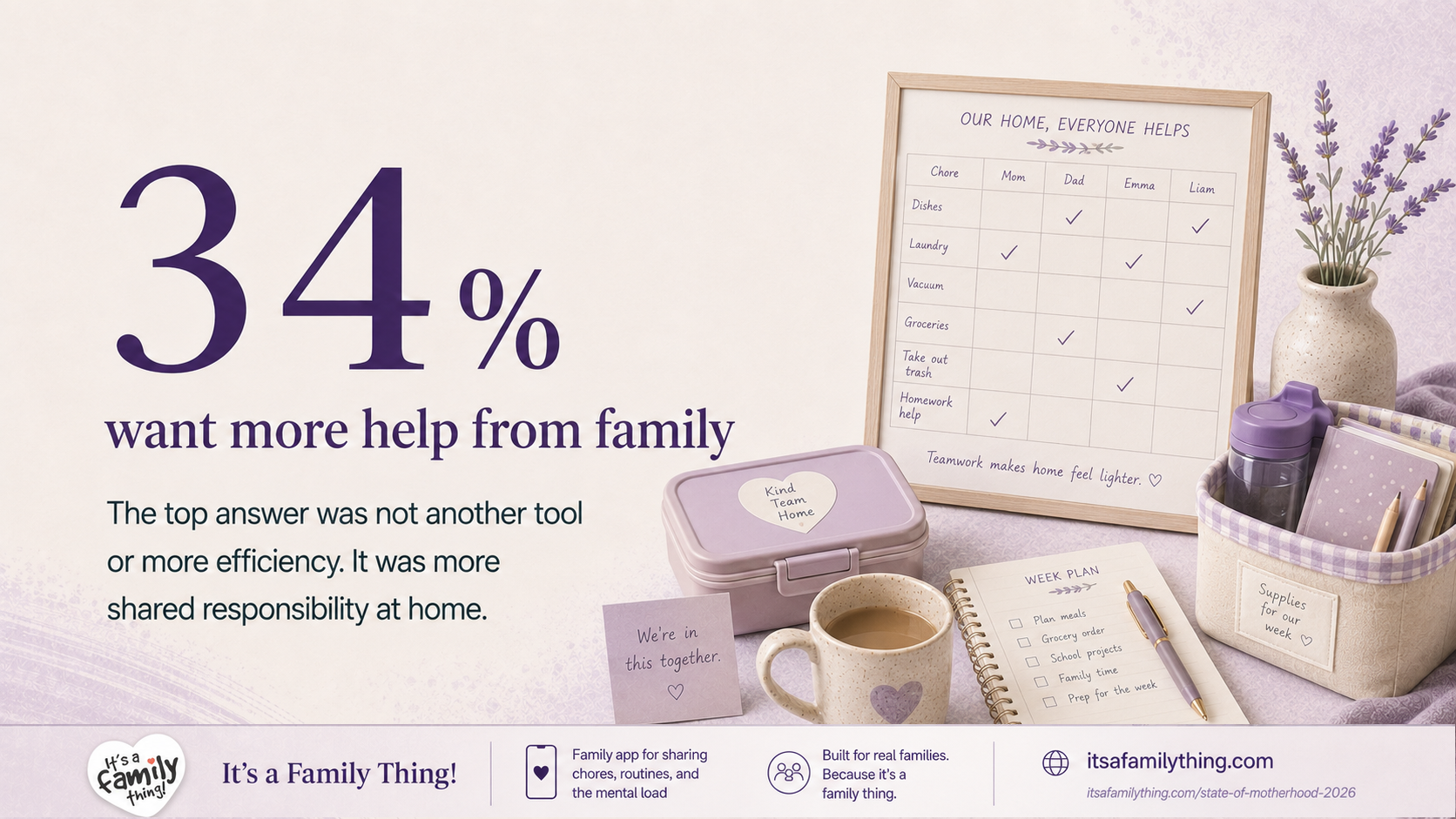
These answers suggest that many mothers are not asking to be more efficient or to manage more. They are asking for less concentration of responsibility.
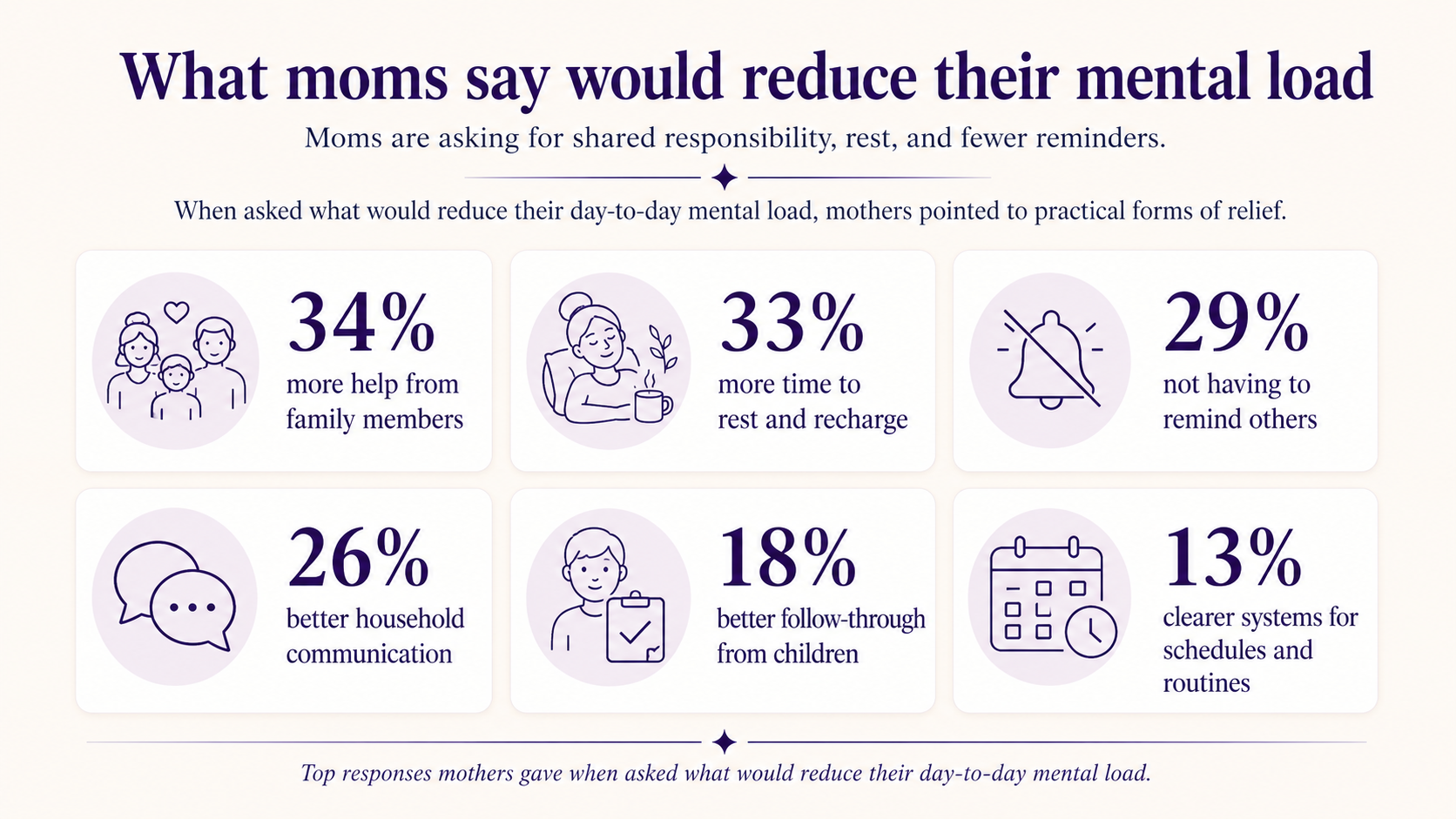
The phrase “mental load” can sometimes sound abstract. But the responses are concrete. Moms want more help. They want more rest. They want fewer reminders. They want better communication and follow-through.
In other words, they want family life to be more shared.
10. What Moms Said in Their Own Words
The desire for relief shows up in simple, practical requests
When mothers were asked what they would like to receive instead of a physical gift, their answers often pointed to relief from everyday responsibility.
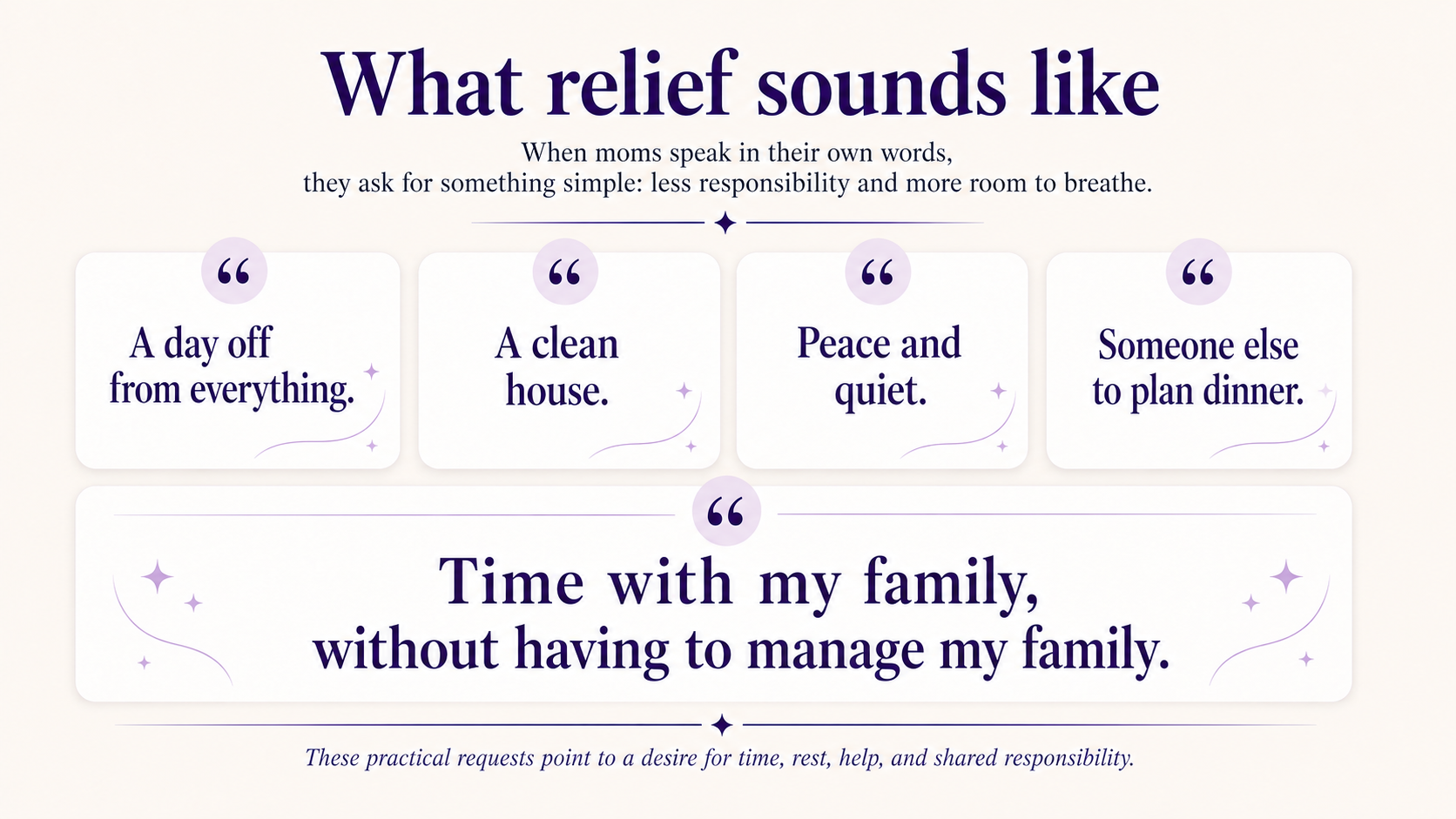
These responses are not extravagant. They are practical. They point to a desire for time, rest, help, and a temporary release from being the person responsible for managing the household.
The responses reinforce one of the main themes of the survey: what many mothers want is not just recognition. They want the load to be shared.
TL;DR
Moms are not just doing more. In many homes, they are still the system keeping everything running.
The survey shows that American moms carry a large amount of visible household work, but the deeper pressure often comes from the invisible coordination behind family life: remembering, reminding, tracking, planning, and following up.
A majority of moms say their household would stop running smoothly within a day or less if they were absent. Many also report limited rest, high survival mode, and emotional strain from being responsible for follow-up.
For working moms, the pressure moves in both directions. Family-life burnout affects work quality, and work burnout affects family life.
What moms say they want is practical: more help, more rest, fewer reminders, better communication, and more shared responsibility.
The big takeaway: this is not just about appreciation. It is about making family life less dependent on one person carrying the load.
What This Means for Families
The findings in this report point to a consistent pattern.
Mothers are doing many visible jobs at home. They are also carrying a less visible layer of coordination that helps the household function: remembering, reminding, tracking, following up, and noticing what needs to happen next.
For many moms, this work takes time each week. It also carries emotional costs, including stress, overwhelm, mental exhaustion, and the feeling of being the only one keeping things running.
The story of modern motherhood is not only that moms are busy. It is that too much of family life still depends on one person’s memory and follow-through.
That matters because systems built around one person’s attention are fragile. They are tiring for the person who carries them, and they make it harder for the rest of the family to share responsibility in a consistent way.
The survey suggests that families do not simply need one person to work harder. They need clearer systems for sharing the work.
That means making responsibilities visible, distributing follow-through, helping children participate, improving communication, and reducing the need for one parent to constantly remind everyone else.
About It’s a Family Thing!
It’s a Family Thing! helps families share the work of running a home.
Built on the foundation of S’moresUp, It’s a Family Thing! gives parents and kids a more supportive way to manage chores, routines, reminders, rewards, schedules, and everyday responsibilities.
The app is designed to help families move from constant reminding to shared follow-through, so the work of family life does not sit inside one person’s head.
How the app helps with what this report found
The survey shows that many moms are carrying the invisible work of remembering, reminding, tracking, planning, and following up. It’s a Family Thing! helps families turn that hidden work into a shared system.
With the app, families can:
Make responsibilities visible
Chores, routines, and daily tasks can be assigned clearly, so everyone knows what needs to happen and who is responsible.
Reduce repeated reminders
Instead of one parent having to keep asking, families can use shared routines, task reminders, approvals, and progress tracking to support follow-through.
Help kids build independence
Children can see their responsibilities, complete tasks, earn rewards, and build everyday life skills through small, consistent actions.
Share the mental load
Schedules, routines, chores, rewards, and reminders live in one place, helping the family participate instead of relying on one person to remember everything.
The goal is not to make families more productive. It is to make family life feel lighter, clearer, and more shared.
Families are fun. Running one should not feel like a chore.
Why It’s a Family Thing! Is Studying This
It’s a Family Thing! was built around a simple belief:
Families are fun. Running one should not feel like a chore.
But for many families, the work of keeping life moving still depends too much on one person remembering, reminding, and following up.
It’s a Family Thing! helps families create shared systems for chores, routines, reminders, rewards, schedules, and everyday responsibility. The goal is not to make families more productive. It is to make family life feel lighter, more shared, and easier to follow through on together.
This report is part of that mission. Before families can share the load, the load has to be named clearly.
Methodology
Talker Research surveyed 2,000 American mothers who have access to the internet. The survey was commissioned by It’s a Family Thing! and administered online between April 6 and April 10, 2026.
Results are based on self-reported data. Cohort cuts include age, region, child age, and employment status.
Unless otherwise noted, figures are based on the full sample of 2,000 moms. Some questions allowed respondents to select multiple answers, so percentages may not add to 100%. Some figures may not add exactly to totals due to rounding.
Derived figures, including visible household work hours, average days before household breakdown, hours spent following up, and annualized workdays lost, should include a calculation note in the final published report.
Media Inquiries
For interviews, data requests, or additional cohort cuts, contact: reeves@smoresup.com
Suggested Citation
It’s a Family Thing!, State of Motherhood 2026: How American Moms Are Really Doing, based on a Talker Research survey of 2,000 American mothers, April 2026.
Copyright © It’s a family thing!